
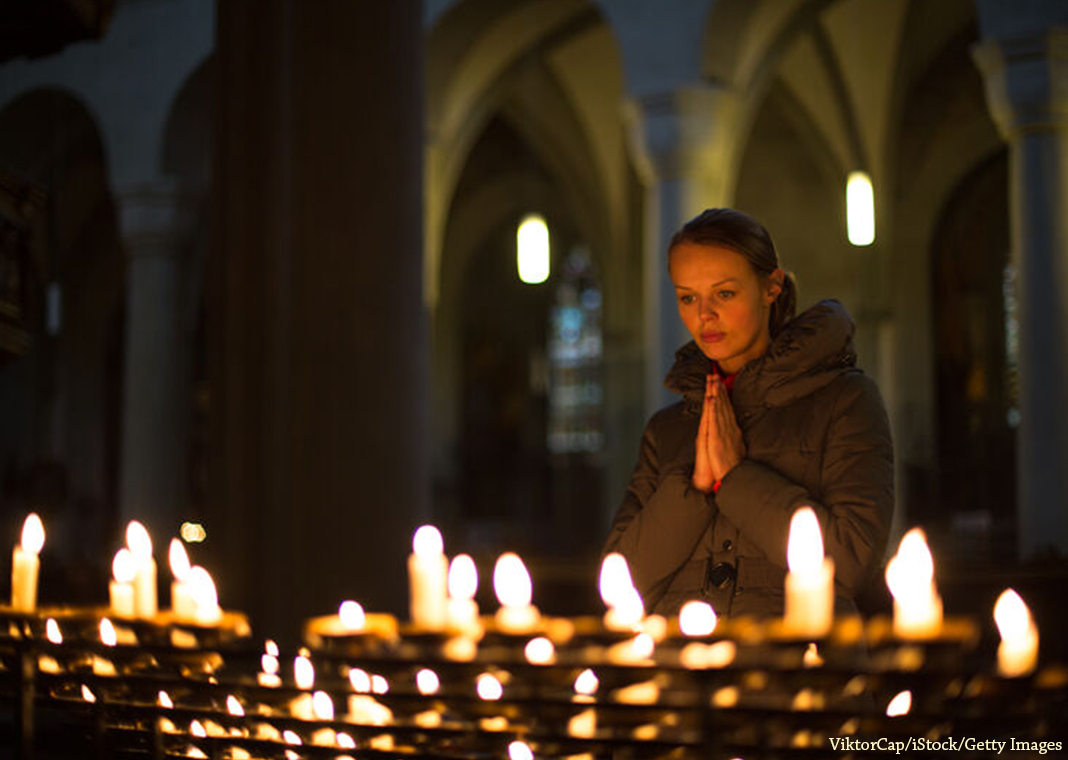
When it comes to inspiration about faith formation, one of my favorite quotes comes from Orthodox bishop and theologian Kallistos Ware, who said, “We see that it is not the task of Christianity to provide easy answers to every question, but to make us progressively aware of a mystery. God is not so much the object of our knowledge as the cause of our wonder.”
The task of becoming progressively aware of mystery is known as mystagogy. The Easter season is when those newly initiated into the Catholic Church enter into the last stage of the Order of Christian Initiation for Adults: the period of mystagogia. To refer to this as a period is a misnomer, however, since the experience of mystagogy applies to the rest of a Christian’s life! All of us who are baptized are in the period of mystagogia.
Becoming progressively aware of mystery is less an exercise in study and more of an exercise of reflection. This process of reflection consists of the following:
- We recall an event or experience that was significant in some way or that caught our attention.
- We share with others who had the same or similar experience, recalling what we saw, heard, tasted, smelled, touched, and how we felt about it.
- We connect that experience to something larger in our lives, especially to our faith, asking ourselves, Where do I find God in this experience? and, What might God be saying to me through this experience?
- We ask how Scripture and Church teaching can shed light on this experience.
- We ask ourselves how we can be transformed as a result of this experience and of our reflection on it.
As we can see, mystagogy is not an academic process, but rather is a spiritual process. There is a distinct process to follow, but there is not a definitive answer that we can expect to arrive at. Rather, we trust the Holy Spirit to guide us to a deeper relationship with God and a progressively deeper awareness of mystery. Mystagogy is not about providing easy answers to life, but rather teaches an approach to life and a deeper appreciation of the mystery of life. The practice of mystagogy involves reflecting on an experience in our life and asking questions such as the following:
What in this experience…
- was good and beautiful?
- caught my attention?
- caused me to grow?
- revealed God’s presence?
- provoked fear, sadness, or despair?
- brought about a sense of calm, hope, or joy?
What from this experience reminds me of a…
- Scripture story?
- story from the life of a saint?
- teaching of the Church?
Next, when we connect our experience to our faith tradition, we ask questions such as:
What from this experience and from my reflection…
- might God be saying to me?
- might God be calling me to be or do?
- have I learned about God?
- have I learned about being a disciple of Jesus?
When we master the art of asking questions of life, we find that our mystagogical mind and heart enable us to work this process in reverse. In other words, when we experience liturgy or hear Scripture proclaimed, we find ourselves drawn to a moment in the liturgy (or a symbol or ritual gesture or song) or a word or phrase in Scripture that leads us to ask, What in my life does this liturgical moment, symbol, ritual gesture, or word or phrase in Scripture remind me of or make me think of and, perhaps, see differently?
By asking questions of life—and by teaching others to do the same—we become—and help others to become—progressively aware of mystery, and, thus, mystagogical!




Wow! Amazing post! If anything will create unity among believers and welcome around questioners (all of us!), this post will! Thank you.
Thanks so much, Mary! Your feedback means so much to me!
Thanks for the article, Joe! Mystagogy indeed is our lifelong tool, and I use it every time I teach my students.
I appreciate that in this process, liturgy and catechesis are intimately connected. Mystagogy forms us to see the world in a liturgical way and to live in the world as Christians filled with the spirit of the liturgy. Because mystagogy’s aim is to form Christians, rather than inform them about Christianity, using mystagogy can strengthen our faith by reinvigorating our liturgy and catechesis. And yes, mystagogy may not change the substantial content of formation, but it does give us a clear starting point for formation that is not merely intellectual but personal.
All of this is say that mystagogical catechesis is a powerful key to authentic formation in the Christian way of life.
Thanks, John Michael! You have always embodied the mystagogical approach, so I appreciate your insights and comments!
Thanks for sharing my new favorite quote! Orthodox bishop and theologian Kallistos Ware, who said, “We see that it is not the task of Christianity to provide easy answers to every question, but to make us progressively aware of a mystery. God is not so much the object of our knowledge as the cause of our wonder.”
You’re welcome, Harry. That quote is a beaut!
Very succinct, inspiring explanation of mystagogy, Joe. Points form your article will be good to share with our parish’s newly confirmed teens. Thank you!
Thanks, Christina. I agree…teens can certainly learn from this. We too often make our confirmation “programs” an academic experience and then we wonder why they see confirmation as graduation!