
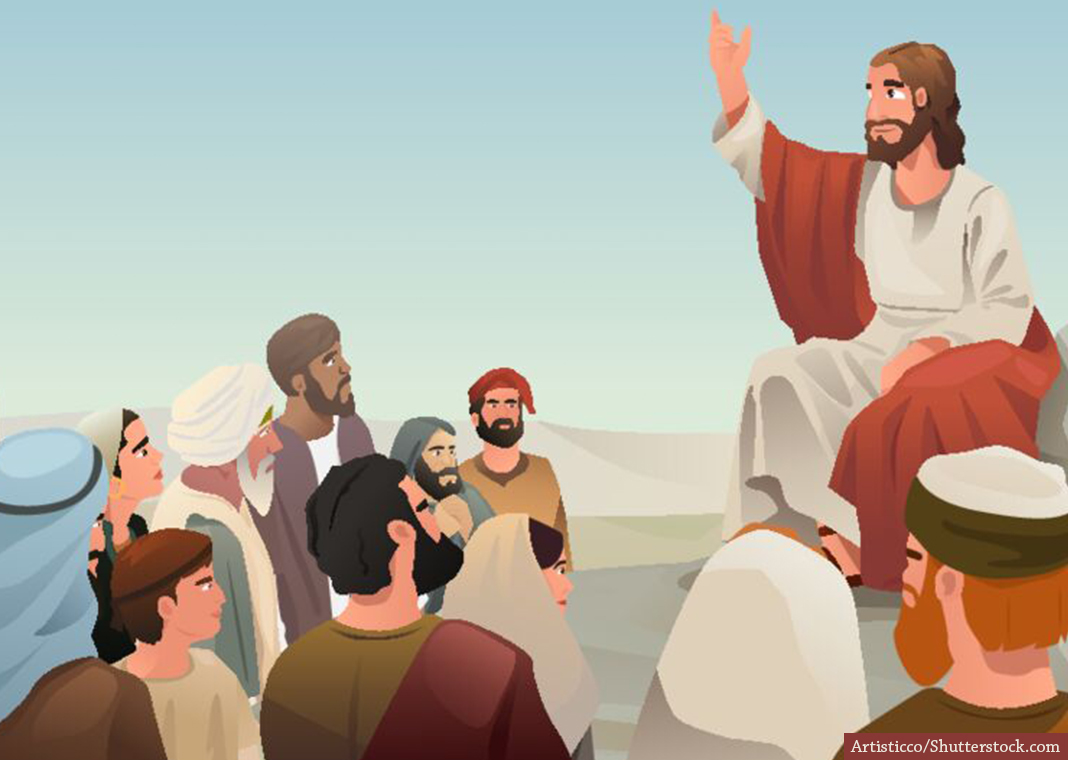
Sheep, fishing nets, pearls, coins, buried treasures, wine, wineskins, yeast, mustard seeds, fig trees, vineyards, tenants, banquets.
These are just a few of the images that Jesus used when he taught. They are images that were familiar to Jesus’ audience. Jesus spoke in such a way that he was able to capture the imagination of the crowds—speaking to their everyday experiences to help them find God in all things.
No doubt, if Jesus were preaching to crowds today and telling parables, he would draw from images that are current, everyday images. This means that, just as Jesus had an openness to the world in which he lived, we too are called to have a spirituality that is characterized by an openness to the world.
From his humble beginnings, Jesus showed an openness to the world. The Incarnation is an example of profound openness to the world. God did not disdain the mundaneness of this world but rather, “God so loved that world that he gave his only Son, so that everyone who believes in him may not perish but may have eternal life.” (John 3:16)
Jesus was sinless, yet he entered into the Jordan River to be baptized with sinners. He did not need forgiveness, but he chose to stand shoulder to shoulder with sinners.
In Jesus’ time, it was customary for Jews who were traveling between Judea and Galilee to avoid passing through Samaria. John 4:4, however, tells us that Jesus did no such thing: “He had to go through Samaria.” He had to? The only reason he had to pass through Samaria was because it was part of his mission.
Now that’s openness to the world. Jesus himself did not flee from the world. Rather, he plunged headlong into the ordinariness of life to reveal the extraordinary presence of God there. Jesus did not tell his followers to run and hide or to separate from society. Rather, he said, “Go!”
That same commission comes to us. We may not fully understand or approve of everything that is happening in the world. However, we must remember that we’re all here together. Our task is to encounter the world and the culture of our neighbors to help each other uncover and recognize the God who is already present.
Being open to the world means learning to speak the language of those we encounter. In doing so, we become capable of doing what St. Ignatius of Loyola taught catechists to do: “Enter through their door, but be sure to leave through your door.”
Let’s pray for ourselves and for one another that we may have a true openness to the world—not disdaining it, but entering into it as Jesus did, so that we can help others recognize God in their midst.
Ponder these reflection questions.
- What are some recent advances in society or technology that have made your head spin?
- If you were to make a time capsule that captures the experience of living in this day and age (and the place where you live), what would you include in it? Why?
- What will you do in the days ahead to strive to be more open to the world?





In reflecting briefly on this most recent post about connecting with teens through their portals, these words from St. Ignatius of Loyola caught my attention: “Enter through their door, but be sure to leave through your door.” Interestingly enough, I have several “door” quotes above my parish office entrance: “…a great door for effective work has opened to me…” 1 Corinthians 16:8a, and this from Pope Francis: “Let us go forth and open doors. Let us have the audacity to mark out new paths for proclaiming the Gospel” and finally, Jesus says in John 10:9, “I am the door; if anyone enters by Me, he will be saved, and will go in and out and find pasture.” AMEN! May each of us find new ways to connect with the youth we serve, leading them ever closer to Christ Who opens windows and doors of all shapes and sizes to reach them!
In regard to the world. We as catechists must understand it but also not accept everything from the world. We are in the world but the world us not our true home. Heaven is the place we are moving towards. We as catechists must be able to challenge the world and still live within it. It is a tough line to walk but God calls us to that challenge
Julie, thanks for your thoughts. I agree that we must not accept everything from the world but we need to do more than understand it…we need to find God in the world and to help others to find God in the world. God loved the world so much that he sent his only Son to dwell among us. The world is not our permanent home but it is our home for the time being and we are not alone – God is with us. The Good News of Jesus Christ is that God has drawn near to his people and is inviting us to “taste” heaven in the here and now as we journey toward our ultimate destination: eternity with God. We are called to do more than endure or tolerate our time on earth. We are called to help the world recognize God’s presence in this world and to invite/challenge the world to more closely reflect God’s Kingdom which has broken into this world through Jesus Christ and yet transcends the world.
The first reflection question asks us to comment on social and/or technological innovations have made our heads spin. For me it is not so much the technology itself that makes me shake my head, but what people decide to do with it. Social media is a perfect example. This technology provides so many benefits in terms of facilitating the giving and receiving of social support and keeping in touch with loved ones. However, these same technologies are with increasing frequency being used as social weapons. This is the only world that my fifth grade CCD students have ever known. My job is to help them understand that anger and hatred never can be allowed to become the norm, and that accepting the guidance of the Holy Spirit gives them the freedom to choose a higher path.