
When it comes to missionary discipleship, we naturally think of the saints. They lived extraordinary lives of holiness, often under great pressure or demanding conditions. The fruit of their lives resulted in miracles that were the fruit of their faithfulness and devotion to God, confirmed with “signs and wonders and mighty works.” (2 Corinthians 12:12)
Of course, we might find it hard to think that our lives of discipleship would be confirmed by signs and wonders of any kind. We might be tempted to think that we are too busy to be missionary disciples, as if discipleship is just one more thing to add to our to-do lists. But discipleship takes many forms, most of which involve small details that we might dismiss as pedestrian or banal.
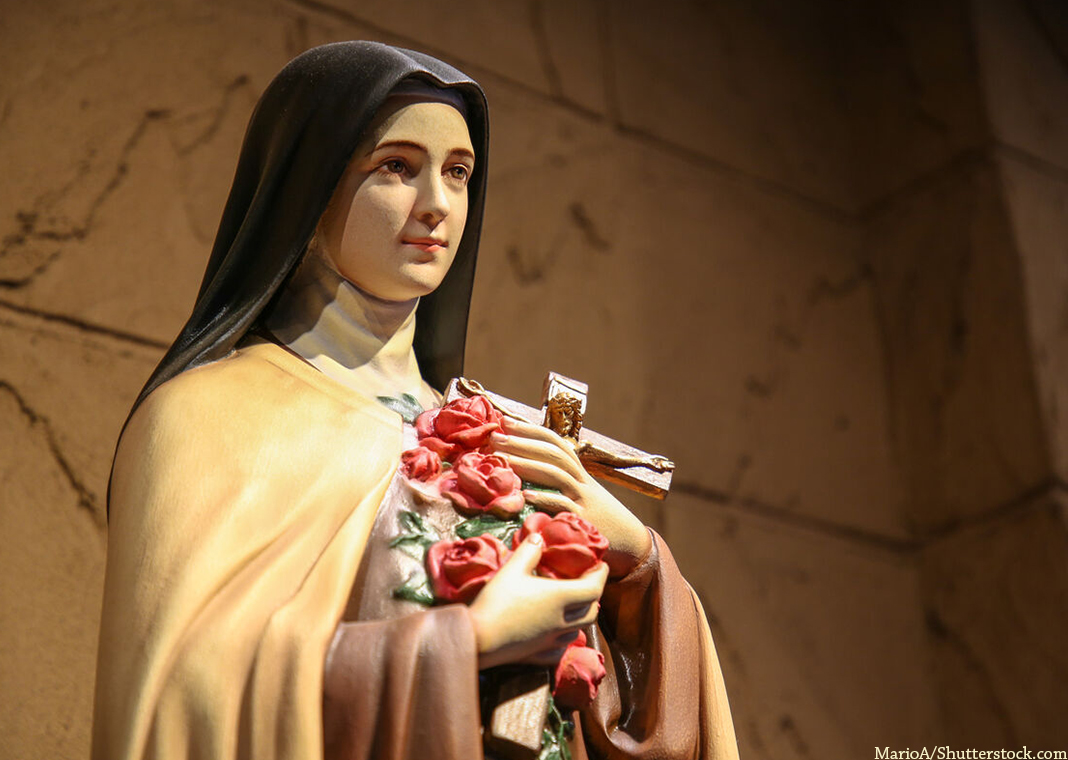
St. Thérèse of Lisieux
The truth is, discipleship takes root in the nooks and crannies of our lives, which is a lesson we learn from St. Thérèse of Lisieux. She pursued holiness through practicing little virtues, because she could not perform great ones. Her devotion through small acts of charity was what she called “her little way to heaven.” St. Thérèse’s life reminds us that the small details of our lives are holy places and touchstones of God’s grace. Her Little Way shows us that being a missionary disciple means doing little things with great love.
We should not overlook or marginalize those whose lives of discipleship reflect a more subtle tone and disposition. Let us remember that holiness is more often found in the small details where God is working in our lives than it is in grand gestures. Pope Francis reminded us “that Jesus asked his disciples to pay attention to details. The little detail that wine was running out at a party. The little detail that one sheep was missing. The little detail of noticing the widow who offered her two small coins.” (Gaudete et Exsultate, #144)
St. Thérèse did not neglect the little details, and neither did Jesus. We need to remember that we can find holiness in the little details of our lives when we attend to them with great love. “A community that cherishes the little details of love,” Pope Francis reminded us, “whose members care for one another and create an open and evangelizing environment, is a place where the risen Lord is present, sanctifying it in accordance with the Father’s plan.” (Gaudete et Exsultate, #145) Let us all be missionary disciples by tending to the little details of our lives with great love.
How do you tend to the small details of love in your life and ministry? How might this help you be a missionary disciple?
St. Martin de Porres
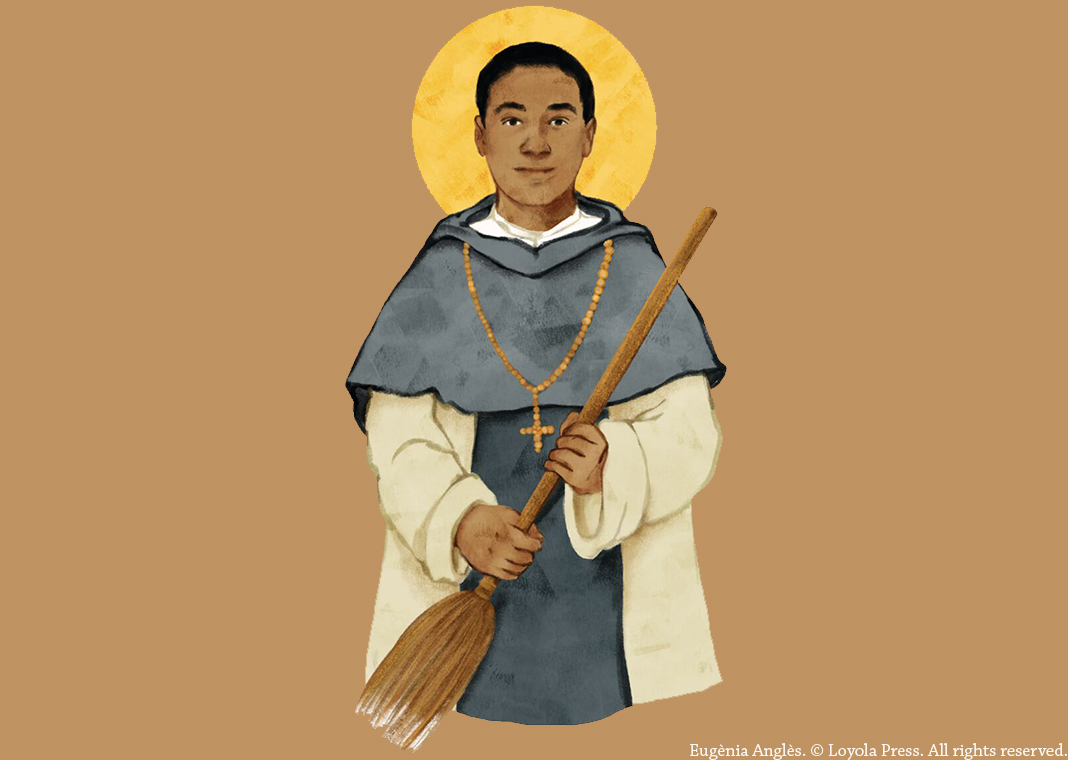
Amid all the upheaval of the world, we sometimes forget that the saints also lived during times of intense disunity, strife, and racial tension. St. Martin de Porres reminds us of the necessity of compassion, particularly during times of difficulty and division. What can his witness teach us about missionary discipleship? Let’s explore his life in a bit more detail.
Martin was born in Lima, Peru, on December 9, 1579, to a Spanish gentleman and a freed slave from Panama of African or possibly indigenous ancestry. He and his younger sister grew up in deep poverty after Martin’s father abandoned the family. Martin worked for a barber, learning to cut hair, and he spent just two years in primary school. Martin was regularly ostracized and bullied because he was of mixed race. He had a desire to enter religious life, but a law in Peru prohibited descendants of Africans or indigenous people from becoming members of any religious orders. Martin begged the Dominicans of the Holy Rosary in Lima to accept him as a volunteer, and in time they did. They assigned him the most menial and lowly tasks, which he carried out with great care and attentiveness. Eventually Martin was accepted as a Dominican lay brother and assigned to the infirmary, where his compassion for taking care of the poor and suffering was noted. Martin went on to develop friendships with both St. Juan Macías, a fellow Dominican lay brother, and St. Rose of Lima, a lay Dominican.
During his years in the monastery, Martin was observed to be compassionate, kind, thoughtful, and pious. He cared for all without distinction, regardless of their race or station in life. All life was precious to Martin, and nobody was overlooked. He even cared for sick or injured animals that were brought to him. In addition to miraculous healings, Martin was reputed to have the gift of bilocation—the ability to appear in two places at once—and soon knowledge of his compassion spread far and wide.
The word compassion means to “suffer together,” and St. Martin certainly suffered alongside those for whom he cared. He endured a debilitating illness and died on November 3, 1639, after pouring out his life for others. St. Martin’s witness reminds us that our concern for the poor comes from a spirit of solidarity, not pity; everyone experiences poverty in some form or another, whether material, spiritual, or moral. Everyone is in continual need of God’s loving mercy and grace.
St. Martin can teach us how to navigate the complexities of race and social indifference while keeping faith at the center of our mission. He didn’t fit into the popular categories of society due to his mixed-race status, poverty, and lack of learning. But we do not remember him for any of these characteristics; we remember his compassionate presence, intentional care, and steady faithfulness. Father Gregory Boyle, in his book Tattoos on the Heart: The Power of Boundless Compassion, notes that kinship is “not serving the other, but being one with the other. Jesus was not ‘a man for others;’ he was one with them. There is a world of difference in that.” As St. Martin teaches us, we too as missionary disciples can make a world of difference, especially to those who are suffering. How is care for the last, the least, and the lost a part of your life and ministry?
St. Brigid
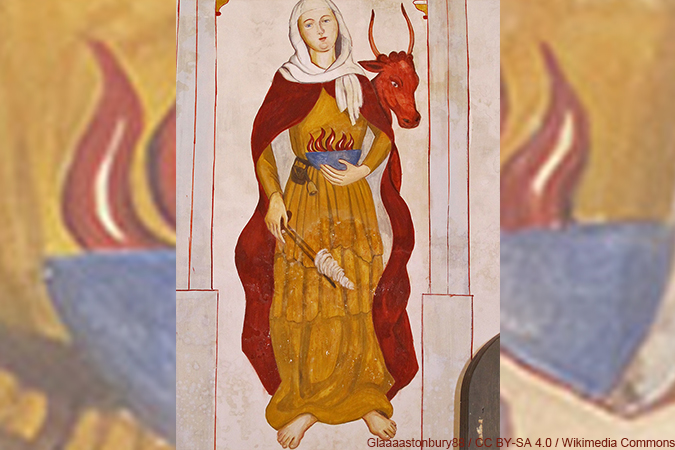 Often called “Mary of the Gael,” St. Brigid of Ireland is one of Ireland’s most beloved saints and was an important part of my life growing up in Ireland. The parish church in my hometown is called St. Brigid Parish, and we celebrated her feast day on February 1 by making St. Brigid’s crosses and welcoming the coming spring. Much of what we know about St. Brigid is a mixture of folklore and myth. Yet at the heart of this woman lies a missionary disciple who used her considerable gifts of healing, hospitality, and leadership to share the core Gospel message, which we call the kerygma.
St. Brigid was born approximately 453 in Faugart, County Louth, to a powerful pagan chieftain name Dubhthach and his Christian enslaved person Broicseach. After being disappointed that Brigid was not the son he wanted, Dubhthach banished Broicseach and sold her back into slavery. As Brigid grew, she was noted for her wisdom, beauty, and love of the poor and marginalized. When she came of age, she successfully searched for her mother and freed her from slavery.
We do not know the details of Brigid’s conversion to Christianity; undoubtedly her mother was a guiding influence in her life. For many years, Brigid pleaded to be sent to a convent, and finally her father relented. She then went on to found one of the most important centers of learning in Ireland at Kildare and used her considerable influence to make Ireland a more just society, where the gifts of men and women were equally recognized.
While the shamrock became identified with St. Patrick, St. Brigid became associated with a simple cross made of rushes. Supposedly woven by Brigid to explain the Paschal Mystery to a dying pagan chieftain, similar crosses are fashioned to this day in Ireland as protection against harm and fire. A poem by Emma Finnegan, which I learned as a child, encapsulates how St. Brigid evangelized by sharing the heart of the Gospel message:
Brigid wove a cross of rushes by a dying chieftain’s bed.
“Brigid what is that you’re making from the rushes there?” he said.Brigid said, “A cross I’m weaving, like the cross where Jesus died.”
“Who was Jesus?” asked the chieftain, “Why was this man crucified?”Brigid told the gospel story to a dying pagan King.
Lying silently he listened, never saying anything.Then he kissed the cross of rushes, saying, “Brigid, thanks to you,
I have come to love this Jesus, I will follow his way too!”
At the center of this poem is, of course, the sharing of the kerygma—the essential message of the life, Death, and Resurrection of Jesus Christ. We are called to witness the kerygma and place it at the center of our ministries. The preface of the Directory for Catechesis reminds us of the words of Pope Francis that “we have rediscovered the fundamental role of the first announcement or kerygma, which needs to be the center of all evangelizing activity and all efforts at Church renewal.”
As missionary disciples, evangelizing through sharing the kergyma must be an integral part of our witness, just as it was for St. Brigid. How is the central Gospel message at the heart of your life? How are you incorporating the kerygma into your ministry?
St. Lorenzo Ruiz
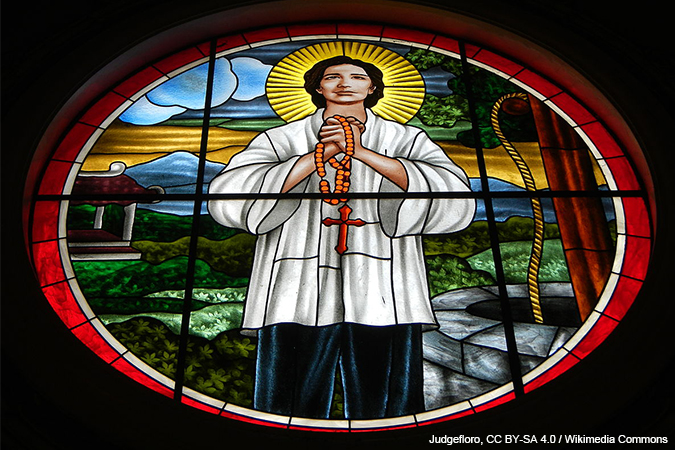
Jesus called ordinary people to become his disciples, and through the gift of faith, they accomplished many extraordinary feats. He transformed simple fishermen and merchants into men and women who utterly altered the society in which they lived. We might not think we are capable of the same kinds of miraculous deeds, but we are. If the thought of carrying out difficult or challenging deeds for the Lord fills you with fear, you are not alone! But the saints have a lot to teach us in confronting and overcoming our fears by exhibiting courage under times of intense stress and pressure. One of the keys to missionary discipleship, as the life of St. Lorenzo Ruiz teaches us, is holy boldness.
Born in 1594 in Binondo, Manila, to a Chinese father and a Filipino mother who were both Catholic, Lorenzo grew up to be multilingual and multicultural. He served as an altar boy and led a quiet and peaceful life. He and his wife, Rosario, had two sons whom he supported by working as a clerk at the Binondo church. Through a strange twist of events, Lorenzo was falsely accused of killing a Spaniard. In danger for his life, Lorenzo fled the country with three Dominican priests and a layman.
They arrived in Japan where the Tokugawa Shogunate—or feudal military government—was heavily persecuting Christians. The men were arrested, thrown into prison, and tortured repeatedly. They faced trial and were taken to Nishizaka Hill where they endured a particularly cruel form of torture known as tsurushi. Bound and hung upside down over a pit, one of the victim’s hands was left unbound so that he could signal the desire to recant his faith. If a person recanted, he was released. If not, the martyr endured a slow and painful death. Despite his intense suffering, Lorenzo steadfastly refused to deny his faith, and he eventually died. His body was cremated, and his ashes were discarded by being thrown into the sea.
In our challenging times, we all face obstacles and, while they are not as dramatic as the ones faced by St. Lorenzo Ruiz and his companions, they can paralyze us. As missionary disciples, we can follow the example of St. Lorenzo Ruiz and call upon the power of the Holy Spirit to give us the courage and boldness to face our fears. As Pope Francis reminded us, “the Holy Spirit also grants the courage to proclaim the newness of the Gospel with boldness (parrhesía) in every time and place, even when it meets with opposition. Let us call upon him today, firmly rooted in prayer, for without prayer all our activity risks being fruitless and our message empty.” (Evangelii Gaudium #259)
As St. Lorenzo teaches us, God is present in the midst of our suffering, and the Holy Spirit will strengthen us in our hour of need. St. Lorenzo Ruiz’s last words before death were, “I am a Catholic and wholeheartedly do accept death for God. Had I a thousand lives, all these to him I shall offer. Do with me as you please.” Praying for the gift of holy boldness when we are faced with difficulties, or even when we feel uncomfortable sharing our faith, will help us to step out in faith.
Where do you see holy boldness lived out today? How can you inspire others to cultivate the gift of holy boldness in their own lives?
St. Brigid of Kildare painting: photo by Glaaaastonbury88 used under CC BY-SA 4.0 via Wikimedia Commons, background effect added.
St. Lorenzo Ruiz photo by Judgefloro, used under CC BY-SA 4.0 via Wikimedia Commons.





Thank You!
Doing little things with great love! This is very much soul touching. Thanks. Our places need this imprint into human hearts more than ever before. In this we would be able to value each and every person with dignity and care. This inspires my day and continuous pastoral approach in my parish of work among the poorest of the poor here in Acumet, Soroti Catholic Diocese, Uganda. God bless you dear J. Stanz for the inspiring reflection.